

Drawing Metes And Bounds Legal Descriptions
 |
 |
 Plot Land |
 Search Alberta Corporate Registrations |
 Edmonton Property Search |
| Lethbridge Property Search |
 County Maps |
 Reserve Maps |
 |
 Site Map |
Plot a Metes and Bounds Legal Land Description
Quick Start
Enter your metes and bounds legal land description.
Check Button
- Will run a syntax check on your data, plot the land parcel and calculate area and closure.
- The starting point should meet up with the ending point. This is called "Closure".
- The acreage should be very close to what is on the legal land description.
- Syntax errors will be highlighted.
- Hover over the highlighted fields to see the error message.
- 'Check' is a Free Service.
Calc Button
- Computes Latitudes and Longitudes for all points.
- Computes arc lengths and chord lengths for all curves.
- Has links to download the point coordinates in CSV, KML, GPX and JSON formats.
- Has links to draw your property on top of Road and Satellite Maps.
- 'Calc' is a Paid Service.
Save Button
- You may create an account without any purchase.
- This allows you to 'Save' your projects.
- 'Save' will also add additional lines to the bottom of the data entry form.
- To 'Save', you must manually click the 'Save' button. This app does not automatically save.
Sales Pitch
Each 'Calc' consumes 1 credit. 'Check' is free and does not consume any credits.
Your first 3 'Calcs' are free.
Typically 20 to 30 credits are required to complete a project.
If you wish to setup an account, click Becoming a Subscriber and follow the instructions.
If already have an account, click here.
Or, you can click "Login" on the top right hand corner of any webpage, sign in, and then click the "PLOT" button on the black menu bar.
Metes and Bounds Land Description
Overview:
- A Metes and Bounds Land Description starts at a well defined beginning point and traces the perimeter of a property using carefully measured distances and angles until it finally returns to the point of beginning.
- The end point must meet up with the start point. (Closure)
Example:
A tract of land in the Northwest quarter of the Northwest quarter of Section 30, Township 1 South, Range 66 West of the 6th Principal Meridian, County of Adams, State of Colorado described as follows:Commencing at the Northwest corner of said Section 30;
Thence South 20°30' East, a distance of 140.60 feet to the Point of Beginning;
Thence North 88°55' East, a distance of 200.00 feet;
Thence South, a distance of 125.00 feet;
Thence South 88°55' West, a distance of 200.00 feet;
Thence North, a distance of 125.00 feet to the Point of Beginning;
Containing 0.57 acres, more or less.
Bearings are based on the north line of the Northwest quarter of Section 30 to bear North 89°42' East with all bearings contained herein relative thereto.
Elements:
- PREAMBLE
- The preamble provides a general description of the land to be described including the county, state and other general information to orient the reader.
- The preamble gets the reader to the proper general location.
- POINT OF COMMENCEMENT
- This is the reference point.
- A Point of Commencement is used to unambigously reference the parcel to a well-established point (ie: a government survey corner).
- A Point of Commencement is used when the reference point is not on the perimeter of the parcel.
- The Point of Commencement is either inside the land parcel or on another land parcel some distance away.
- There might not be a Point of Commencement.
- POINT OF BEGINNING (POB)
- The Point of the Beginning is "pen down", the first point where the drawing of the perimeter begins.
- If there is no Point of Commencement, the Point of Beginning is also the reference point.
- BODY
- The Body contains a sequence of Calls.
- These Calls draw the perimeter around the land parcel and end up back to the Point of Beginning.
- Calls recite Courses and Distances.
- Calls can be a straight line, a curve, or a line parallel line to another line.
- Calls can be references to adjoining boundaries, natural or artificial monuments, roads or rivers.
- Courses are the direction of a line.
- Courses are usually referenced to true north, but sometimes are referenced to magnetic north or a Basis of Bearing
- Distance is the length in a well-known unit, such as feet, meters or chains.
- AREA
- An Area Call sets forth the approximate acreage in the parcel.
- The acreage in the Area Call should be very close to the calculated area as defined by the sequence of calls in the Body.
- BASIS OF BEARING
- A Basis of Bearing is used instead of true north or magnetic north as the reference for the Courses.
- A Basis of Bearing is rare, most legal descriptions do not have one.
- If a land description has a Basis of Bearing, it will be explicity stated. Otherwise leave the Basis of Bearing fields blank.
Operating Instructions | |
Field | Description |
| Project Name | A short description of the land parcel The Formal Description of the Land Parcel (It makes your printed out documents look better) |
| Ellipsoid | Size and Shape of the Earth The Earth is not completely round sphere, it is an ellipsoid. The Earth bulges out at the equator, like when a child sits on a beach ball. There are slightly different sets of numbers used to describe the ellipsoid shape of the earth. Some are newer and more accurate. Some work better on a specific part of the earth, like the area around Mount Everest. If unsure, leave this field blank. ELLIPSOIDS Semi-major Semi-minor Equatorial Polar Inverse axis (m) axis (m) flattening Name a b 1/f ---------------------------- --------------- ---------------- --------------- Airy 6377563.396 6356256.91 299.3249753 Modified Airy 6377340.189 6356034.446 299.3249646 Australian National 6378160 6356774.7192 298.25 Bessel 1841 6377397.155 6356078.9629 299.1528128 Bessel 1841 (Namibia) 6377483.865 6356165.383 299.1528128 Clarke 1880 6378249.145 6356514.8696 293.465 Clarke 1866 (NAD27) 6378206.4 6356583.8 294.9786982 Everest 1830 6377276.34518 6356075.41511 300.8017 Everest 1948 6377298.556 6356097.55 300.8017 Mod. Everest 1948 6377304.063 6356103.039 300.8017 Everest 1956 6377301.243 6356100.228 300.8017 Everest (Pakistan) 6377309.613 6356108.571 300.8017 Mod. Fischer 1960 6378155 6356773.32 298.3 GRS80 (NAD83) 6378137 6356752.31414 298.257222101 GRS-80 CHINA 6378140 6356755.288 298.257 Helmert 1906 6378200 6356818.17 298.3 Hough 1960 6378270 6356684.34343 297 Indonesian 1974 6378160 6356774.504 298.247 International 1924 6378388 6356911.9462 297 Krassowsky 1940 6378245 6356863 298.3 SGS 85 6378136 6356751.302 298.257 South American 1969 6378160 6356774.7192 298.25 WGS72 6378135 6356750.52 298.26 WGS84 6378137 6356752.314245 298.257223563 Airy 1830 6377563.541 6356257.053 299.325 Clarke 1858 6378361 6356685 294.26 Clarke 1880 French 6378249.2 6356515 293.46598 Clarke 1880 Mod. 6378249.145 6356514.966 293.466307656 Clarke 1880 Palistine 6378300.79 6356566.435 293.466307656 Clarke 1880 6378249.145326 6356514.966721 293.4663076 Danish 6377104.43 6355847.415 300 Delambre 6376523.3 6355863.232 308.64 Everest 1969 6377295.664 6356094.668 300.8017 Fischer 1960 6378166 6356784.284 298.3 GRS 1967 6378160 6356774.504 298.247 Hayford 1909 6378388 6356909 297 Plessis 6376523.3 6355863.232 308.64 Schott 1900 6378157 6357210.672 304.5 Struve 6378298.3 6356657.143 294.73 War Office 1924 6378300.58 6356752.267 296 WGS 60 6378165 6356783.287 298.3 WGS 66 6378145 6356759.769 298.25 ---------------------------- --------------- ---------------- --------------- |
| Line | Line Number Line Number is not part of a legal land description. It is used by this application to provide a reference to a specific line of the input form during error checking. The Line Number is also used to label points on the drawing that do not have a Point Name. |
| Latitude Longitude | Starting Latitude & Longitude This is the critical starting point used to calculate all the other Latitudes and Longitudes. Care and attention are required. Latitude and Longitude to 5 decimal places is about a meter. The Latitude and Longitude are entered in decimal degrees, with Longitude being a negative number in the Western Hemisphere. The MGRS app can be used to convert a Degree, Minutes, Seconds into Decimal Degrees. Entering a Latitude and Longitude is recommended, especially if you require results accurate to many decimal places. This app will compute *OK* without the starting latitude and longitude for distances of a few hundred feet. But if you have lengths that cover miles, then the curvature of the earth will have a significant effect on your Closure distance. SectionalIn the parts of the United States covered by the Public Land Survey System and the parts of Canadian provinces covered by the Dominion Land Survey, the starting Latitude and Longitude are often corners that can be obtained by using one of our sectional land description converters.
Government Databases
Physically get the GPS of the Starting Position
|
| Point Name | Name of this Point The Point Name is used by the legal text to name a point that will be referenced later on in the same document. The Point Name is used to label the point on the drawing. |
| Begin | Point of Beginning "Pen Down". Drawing of the Perimeter begins. |
CoursesCourses are the directions to move. This application accepts courses in in 2 formats. | |
| Cardinal | North, South, East and West, Northwest, Northeast, Southwest and Southeast Cardinal Directions are simply stated as words. Degree, Minutes and Seconds are left blank. East/West is also left blank. |
| Bearing | North|South, Degree, Minute, Second, East|West The Compass is divided into 4 quadrants. Directions start at either North or South and proceed at an angle towards East or West. At least one of the degree, minute or second fields must be filled in. In this application, the Bearing field is also used to hold the "Central Angle" when plotting curves. |
Distance | |
| Length | Length is a positive number with up to 8 decimal places. In this application, the "Length" field is also used to hold the "Radius" when plotting curves. |
| Unit | Unit Measures Land Surveying Units of Measures. These well know units of length are accepted. Unit Meters ------------- --------------- Foot 0.3048 Yard 0.9144 Chain 20.1168 Link 0.201168 Rod 5.0292 Meter 1 Inch 0.0254 Furlong 201.168 Perch 5.0292 Pole 5.0292 Mile 1609.344 Kilometer 1000 League 5556 US Foot 0.30480061 ------------- --------------- US Survey Foot If unsure, select "Foot" rather than "US Foot" in the unit drop down. Since 1893, the legal definition of the foot in the United States has been based on the meter. The definition adopted by Congress in 1866 was 1 US Foot = 1200/3937 meter exactly. In 1959, the relationship of the foot to the meter was officially changed to what it is today: 1 Foot = 0.3048 meter exactly. U.S. Survey Foot (NIST) Although the difference is small, across the distance of an entire state, it becomes significant. |
Basis of Bearing | |
| Bearing | A Basis of Bearing is used instead of true north or magnetic north as the reference for the Courses. If there is no Basis of Bearing, leave these fields blank. |

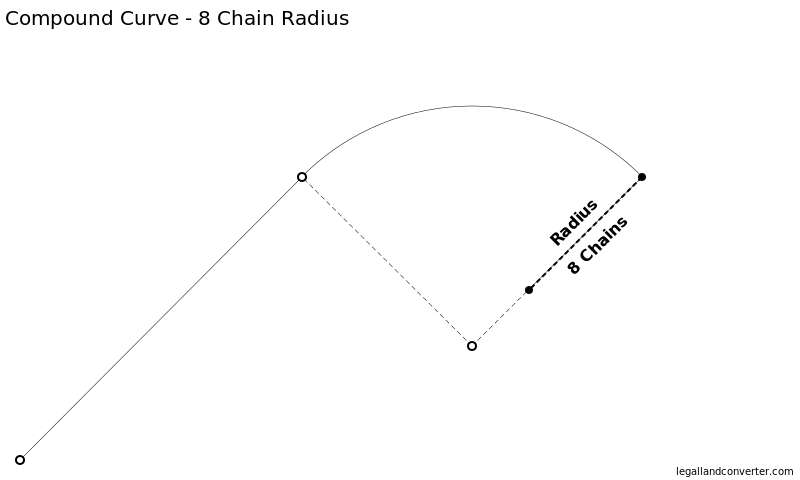
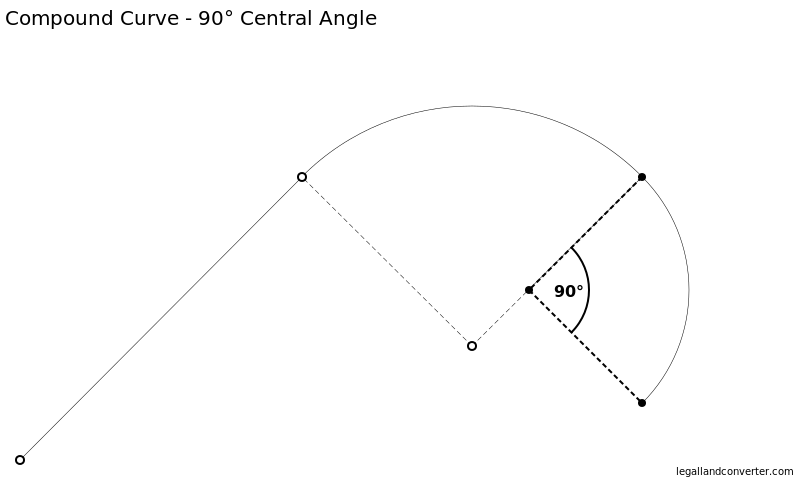
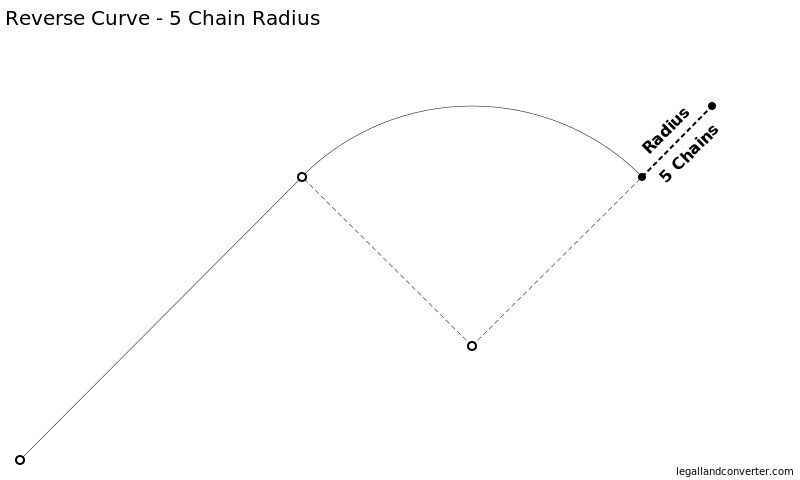
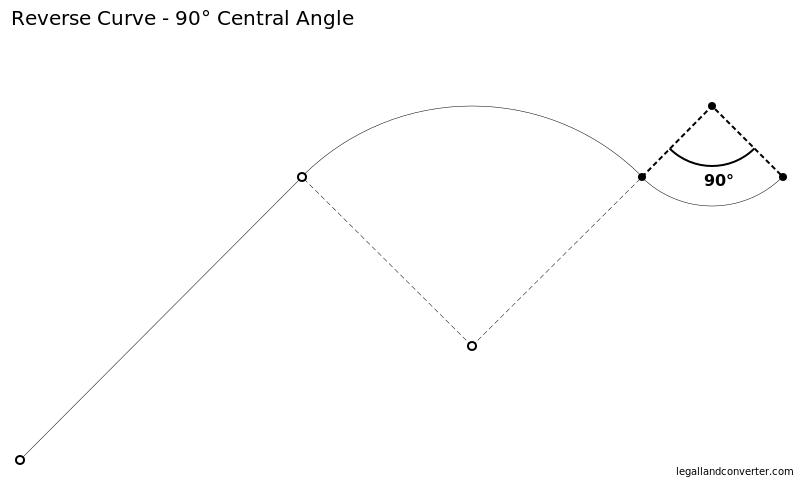
Curves
Left, Right, Compound & Reverse Curves
Enter in the Central Angle in the Degree/Minute/Second fields.
Enter the Radius in the Length/Radius field.
The radius is the radius of the curve. The central angle is the angle swept.
In a legal description of a curve there should also be a "length" or "distance" of a curve.
These lengths should be qualified as either "arc length" or the "chord length".
The arc lengths and chord lengths are not used to compute the curve, they are included as a "math" double check.
As an additional double check, many descriptions also include words like "Southwesterly" or "Northerly" to describe the general direction of a curve.






Sectional Land Descriptions
Sectional Land Descriptions are subdivided by a grid system.
These are found by using these fill-in-the-form programs
| Link | Area | Grid Name | Example | |
| PLSS | USA | Public Land Survey System | S2 T35N R21W Chisago County, Minnesota Section 2, Township 35 North, Range 21 West, Fourth Principal Extended | |
| DLS | Canada | Dominion Land Survey | SW 24-12-20-W4 Southwest Quarter of Section 24, Township 12, Range 20, West of the 4th Meridian. | |
| NTS | Canada | National Topographic System | C-26-F/93-K-11 Series 93, Area K, Sheet 11, Block F, Unit 26, Quarter C | |
| FPS | Canada | Federal Permit System | Yellowknife 38 62-30 N 114-15 W Hay River F 72 61-00 N 115-30 W | |
| UTM | Global | Universal Transverse Mercator | 12N 384323 5540791 | |
| MGRS | Global | Military Grid Reference System | 12U UA 84323 40791 12U UA 84 40 |
Legal Land Description References
- Interpretations of Real Property Descriptions
Florida Association of Cadastral Mappers
The Florida Department of Revenue
FACM Course 3 - Reading and Understanding Legal Descriptions
David Lawson
Washington Underwriter
Fidelity National Title Group
Washington Land Title Association - October 2018 - North Caroling Property Mappers Association
Advanced Mapping
Section 5-C
Curves - Specifications for Description of Tracts of Land for Use in the Land Orders and Proclamations
U.S. GOVERNMENT PRINTING OFFICE
Stock Number 024-011-00117-4 - Guidelines for Writing Legal Descriptions
State of California
- The Zigs and Zags of Legal Descriptions
by Alan C. Morganfield, SR/WA, PLS
by Charles Carpenter, ESQ
- Legal Descriptions
by R.W. "Russ" Forsberg, PLS
- Land Description Principles
By: William C. Rohde, RLS 841
Wisconsin Land Surveyor
Retired
- How to map property boundaries from a deed
http://www.waldeneffect.org
by Anna Hess and Mark Hamilton
- Property Descriptions
The types of legal descriptions used for real property in the United States.
Surveying References
- Basic Surveying - Theory and Practice
Oregon Department of Transportation
Geometronics Unit
- Highway Surveying Manual
Washington State Department of Transportation
Environmental and Engineering Service Center
Design Office
M 22-97 January 2005
Chapter 11 : Geometrics - Finding Survey Marks and Datasheets
National Geodetic Survey
- Search BLM GLO Records
U.S. Deptartment of the Interior
Bureau of Land Management
Choose "Surveys" to find Platt Image
- Content Requirements for Survey Plans and Sketches
Government of Alberta
Public Land Dispostions
https://www.alberta.ca/survey-sketch-plans.aspx
- 2020 Manual of Standard Practice
Alberta Land Surveyor's Association
https://www.alsa.ab.ca/
| Login |
| Becoming a Subscriber |
| Create Account |
| Purchase Credits Online |
 Alberta Rural Address Search |
 Public Land Survey System (PLSS) |
| PLSS Batch Converter |
 Military Grid Reference System |
 National Topographic System |
 Federal Permit System |
 Universal Transverse Mercator |
 Canada DLS & ATS |
 Canadian Batch Converter |
| Canadian Batch Converter Help |
| Contact Us |
Drawing Metes And Bounds Legal Descriptions
Source: https://legallandconverter.com/p76.html
Posted by: yanceythawased.blogspot.com
0 Response to "Drawing Metes And Bounds Legal Descriptions"
Post a Comment